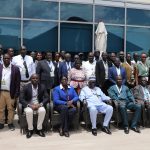



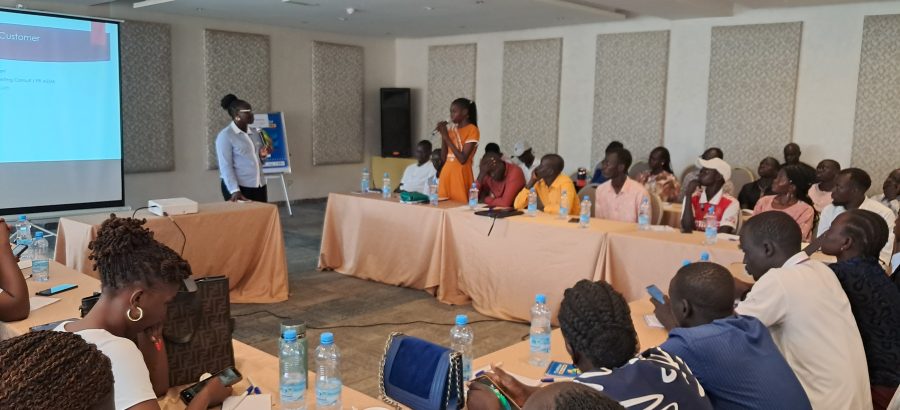
March 23-26, 2026 (JUBA, South Sudan) Organized by ICPALD’s AfDB-funded EIDFR Project, in partnership with University of Juba, an intensive four-day incubation immersion for youth-led startups was held to support co-founders of 20 startups that recently secured their first seed funding tranche.
IGAD’s Head of Mission to South Sudan, Dr. Victoria Anib, delivered the opening remarks at the workshop welcoming the participating entrepreneurs and commending their commitment to translating innovative ideas into viable businesses despite the challenging operating environment. She underscored the importance of the workshop as a critical transition point from ideas to execution, particularly for startups that have already received seed funding and are now focused on delivering tangible results.
She highlighted that youth entrepreneurship remains central to South Sudan’s economic recovery and resilience, noting that young entrepreneurs are not only job seekers but also job creators with the potential to drive inclusive growth and stability. In this regard, she emphasized the need to strengthen accountability in resource utilization and market-oriented thinking among startup founders.
Further, she encouraged participants to actively engage with mentors, learn from each other’s experiences, and fully leverage the opportunity to refine their business models and accelerate implementation.
The workshop was conducted to accelerate business implementation, strengthen operational capacity, and ensure effective utilization of seed funds among youth-led startups. It blended structured mentorship with local entrepreneurs, peer learning among founders, and field visits to agro-processors in Juba—turning ideas into real business traction.
At the conclusion of the workshop participants had:
- Improved Go-to-Market Strategies: Startups refined their market entry approaches aligned to local realities.
- Enhanced Operational Efficiency: Participants developed practical cost-management and optimization plans.
- Strengthened Peer Learning: Entrepreneurs exchanged real-world solutions, accelerating problem-solving and reducing trial-and-error.
- Completed Business Diagnostics: Startups developed supply chain maps, identified bottlenecks, and designed actionable improvement plans.
- Strengthened Ecosystem Linkages: Collaboration opportunities emerged across startups (input sourcing, technical support, marketing, and certification guidance).
- Undergone Experiential Learning: Site visits to Woodland Apiary provided hands-on exposure to food safety standards, processing, and operational best practices.
With clear action points and timelines in place, the startups are well-positioned to accelerate business growth, create jobs, and contribute to economic resilience in South Sudan. Close monitoring is needed to ensure delivery of results ahead of project closure.
###