

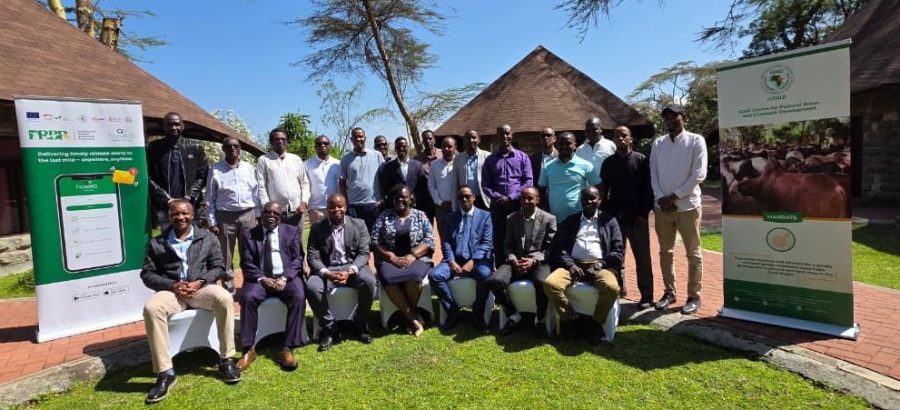
February 11-13, 2026 (NAIVASHA, Kenya) The Technical Working Group (TWG) training for IGAD lusters I, II and III was convened with funding from GIZ under the Peaceful and Resilient Borderlands Programme (PRBP) framework.
In attendance were ICPAC, ICPALD, GIZ technical officers (epidemiology and diagnostics specialists) from Ethiopia, Kenya, Somalia and South Sudan, representing national and sub-national animal health authorities across IGAD Clusters I, II and III.
The session was officially opened by Dr. Romona Andanyi on behalf of the Director of Veterinary Services Kenya. In her remarks, she underscored the increasing threat of TADs in pastoral borderlands, the urgent need for coordinated, risk-based surveillance approaches, the importance of digital systems in enhancing real-time reporting & outbreak response, and the responsibility of TWGs to translate policy agreements into operational collaboration.
Speaking on behalf of the ICPALD Director, ICPALD’s Animal Health Expert, Dr. Wamalwa Kinyanjui, emphasized ICPALD’s commitment to strengthening regional animal health coordination, operationalizing information-sharing protocols, and institutionalizing TWGs as sustainable cross-border platforms
Mr. Tonny Mwaniki representing GIZ highlighted the linkage between animal health, resilience, livelihoods, peacebuilding and regional stability in borderland clusters, reaffirming GIZ’s support toward strengthening digital early warning systems and cross-border cooperation.
The training aimed to strengthen technical capacity and cross-border animal health early warning systems by equipping TWG members with skills in epidemiological surveillance, risk-based monitoring, laboratory diagnostics, and interoperable digital surveillance systems through integration of KABS, ADNIS, and DOVAR into the HUSIKA regional platform.
Participants reaffirmed commitment to:
- Operationalizing MoUs and information sharing protocols.
- Enhancing risk-based and syndromic surveillance.
- Integrating KABS, ADNIS and DOVAR into HUSIKA.
- Strengthening laboratory-epidemiology linkages.
- Sustaining TWG coordination mechanisms beyond project support.
The cluster action plans developed during the training will guide implementation over the next 6–12 months, with emphasis on early warning, outbreak prediction, and coordinated cross-border response to priority TADs.
###
Background
The IGAD borderland clusters—Karamoja (Cluster I), Moyale (Cluster II), and Mandera Triangle (Cluster III) are predominantly pastoral and agro-pastoral zones where livestock mobility across borders is central to livelihoods, trade, resilience, and food security. Seasonal migration to access or in search of pasture and water, coupled with dynamic formal and informal livestock trade, sustains millions of households in these regions. However, these same mobility dynamics combined with porous borders, climate variability, recurrent droughts, insecurity, conflict over natural resources, weak infrastructure, and limited veterinary service coverage create high-risk conditions for the introduction and spread of priority TADs.
Although a signed Memoranda of Understanding (MoUs), Implementation Frameworks and an Animal Health Information Sharing Protocol exist among participating countries, their operationalization has remained limited due to gaps in national resource allocation, technical capacity, epidemiological analysis, laboratory diagnostics, digital interoperability, and risk-based surveillance systems.
National digital animal health surveillance systems: Kenya Animal Bio-Surveillance (KABS) System in Kenya, and the Animal Disease Notification and Investigation System (ADNIS) & Disease Outbreak and Vaccination Activity Reporting System (DOVAR) in Ethiopia generate valuable disease intelligence.
At the regional level, HUSIKA provides a multi-hazard early warning and communication platform. However, structured integration and interoperability between national systems and HUSIKA have not been fully operationalized.
*HUSIKA is a multilayered, multi-hazard early warning and communication platform designed to enhance disaster resilience in the greater Horn of Africa