


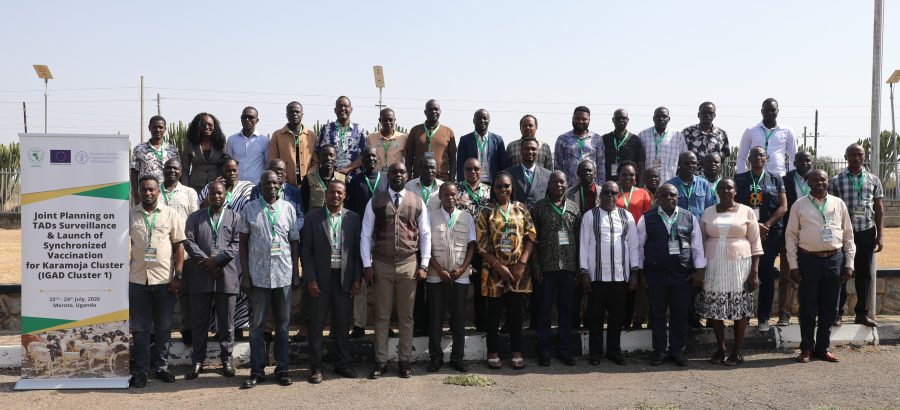
July 22-24, 2026 (MOROTO, Uganda) — Building on the signed 2019 Karamoja Cluster Multilateral Animal Health Cooperation MoU, the Joint Transboundary Animal Diseases (TADs) Surveillance and Planning for the Karamoja Cluster Synchronized Vaccination Programme convened by ICPALD brought together animal health authorities and partners from Ethiopia, Kenya, South Sudan and Uganda.Welcome remarks were made by Dr. Dominic Kathiya, on behalf of ICPALD’s Director; Dr. Wellington Bessong, represented FAO Uganda, while Dr. Dan Tumusiime spoke on behalf of the Commissioner for Animal Health, Ministry of Agriculture, Animal Industry and Fisheries (MAAIF), Uganda.
All speakers welcomed the delegates and noted that the presence of country representatives demonstrated the strong commitment to work collectively towards safeguarding livestock health, protecting pastoral livelihoods, strengthening regional trade, and improving food security across shared borderlands. They commended the represented Member States, together with FAO and other partners, for their commitment to this important regional initiative.
The forum aimed to strengthen cross-border coordination between the four IGAD countries for the prevention and control of TADs through harmonized surveillance, synchronized vaccination and timely information sharing within the Karamoja Cluster.
Additionally, participants reviewed implementation progress of the Karamoja Cluster Animal Health Cooperation MoU, developed a joint 2026 surveillance & vaccination plan, and officially launched the synchronized vaccination campaign against Foot and Mouth Disease (FMD) and Peste des Petits Ruminants (PPR).
Plenary presentations highlighted ongoing government- and partner-supported cross-border animal health initiatives aimed at strengthening surveillance, vaccination, laboratory capacity, animal identification & traceability, and digital disease reporting systems.
Specifically featured were the opportunities for collaboration and complementarity among projects, sustainability of interventions, and the key challenges affecting effective implementation of cross-border animal health programmes, including resource, policy, logistical and coordination gaps.
During group discussion sessions the annual harmonized joint surveillance and synchronized vaccination calendar and implementation plan for Karamoja cluster was produced. In it was the recommendation to strengthen the adoption and interoperability of digital disease surveillance systems, an inventory of cross-border animal health capacities and infrastructure to support coordinated TAD prevention and control, and a mapped overview of livestock mobility routes, border crossing points, markets, grazing and watering areas, as well as animal health and inspection facilities to guide risk-based surveillance, vaccination and cross-border disease management (Annex 1).
A key milestone was the launch of the synchronized PPR and FMD vaccination campaign, which commenced in Uganda on 23 July 2026 and continued in the border areas of Kenya on 24 July 2026. This coordinated approach targets a significant reduction of the risk of re-infection across borders by ensuring that susceptible livestock populations are protected simultaneously.
📍 Launch of synchronized vaccination in Tapac Sub-County Katikekile Parish, Nauit Village, Moroto District, Uganda
It was witnessed by administrative leaders including Benon Kwikirisa, the Resident District Commissioner of Moroto District from Uganda, technical teams from Ethiopia, Kenya, South Sudan and Uganda, as well as representatives from FAO, Reconcile, community-based organizations (CBOs) and other partners. Thereafter a learning visit at the Karamoja Regional Veterinary Laboratory took place.
📍 Launch of synchronized vaccination in Nasal Village, Lokitonyala Location, Pokot North Sub-County, Kenya
It was witnessed by County administrators including area Chief and Assistant County Administrator from Kenya and technical teams from Ethiopia, Kenya, South Sudan and Uganda, as well as representatives from FAO, Reconcile, community-based organizations (CBOs) and other partners.
This initiative was funded by the EU under PLACE Project.
###
Background
The Karamoja Cluster is a shared cross-border pastoral ecosystem spanning Ethiopia, Kenya, South Sudan and Uganda, where livestock mobility is central to livelihoods, food security and regional trade. Seasonal movement of livestock to access or in search of pasture, water and markets facilitates social and economic interactions but also increases the risk of transboundary spread of animal diseases such as Foot and Mouth Disease (FMD), Peste des Petits Ruminants (PPR), Contagious Bovine Pleuropneumonia (CBPP), Contagious Caprine Pleuropneumonia (CCPP), Rift Valley Fever (RVF) and other priority diseases.
Effective prevention and control of these diseases require coordinated regional approaches that transcend national boundaries through harmonized surveillance, timely information sharing, synchronized vaccination and joint outbreak response. These diseases cannot be effectively controlled by one country acting alone. Their successful prevention and control require coordinated planning, synchronized implementation, timely information sharing and joint surveillance among neighboring countries.
To strengthen regional cooperation ICPALD) with support from the PLACE (Pastoralism and Livestock Adaptation to Climate Change in Eastern Africa) Programme and in collaboration with Member States and partners, facilitated the development and signing of the Karamoja Cluster Multilateral Animal Health Cooperation MoU, together with its Implementation Framework and Information Sharing Protocol in 2019.