

A Makerere University needs assessment of 106 frontline personnel across the PASSAGE project landscape, supported by IDRC-Canada and led by IGAD
By Anthony Egeru and Gordon Yofesi Mwesigwa – Department of Environmental Management, Makerere University
If there is one number in Makerere University’s latest needs assessment that should energise policymakers, it is this: 103 of 106 frontline personnel surveyed across the Greater Horn of Africa’s pastoral landscapes — 97.2% — said yes, unambiguously, when asked whether they would join a knowledge and learning hub focused on early warning information. Not “maybe, if it’s convenient.” Not “possibly, depending on funding.” The remaining three respondents said “maybe.” Not a single person said no.
| 97.2% would join a knowledge hub
103 of 106 respondents said yes outright — the strongest single signal of demand anywhere in the survey. |
In survey research, numbers that clean are rare, and they are almost never accidental. They are a signal. For the IDRC-Canada-funded, IGAD-led PASSAGE project — Strengthening Pastoralist Livelihoods in the African Greater Horn through Effective Anticipatory Action — this one suggests that the knowledge and learning hubs at the heart of its design are not a hard sell. The demand already exists, fully formed, across Karamoja, Turkana and Marsabit, Borana, South Sudan’s Equatorial States and Mandera. The opportunity now is to build hubs shaped by exactly what respondents say they need.
What people want to learn
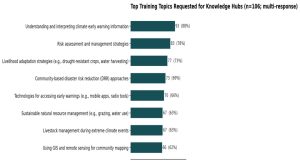
Asked which topics should be prioritised in training workshops, respondents converged overwhelmingly on the fundamentals of interpretation over the mechanics of technology. Understanding and interpreting climate early warning information itself topped the list, named by 87.7% of respondents — more than any specific tool, app or platform. Risk assessment and management strategies followed at 78.3%, then livelihood adaptation strategies such as drought-resistant crops and water harvesting (72.6%), community-based disaster risk reduction approaches (68.9%), and the technologies used to access warnings in the first place, such as mobile apps and radio tools (66.0%).
This ordering matters. It suggests that the bottleneck in the Greater Horn’s early warning ecosystem is not primarily about access to information — as earlier sections of this same survey show, most organisations already receive some form of climate-related information — but about the skills to make sense of it and act on it with confidence. A hub that simply pushes more data at communities without investing first in interpretation and risk literacy would be solving the wrong half of the problem.
The skills gap technology alone won’t fix
The survey also asked respondents to rate their own capacity to use eight categories of early warning tools and technologies, from GIS mapping to climate-smart agriculture. The results expose a telling split. Tools rooted in familiar, community-facing practice score well: 70.8% rate their skills with mass media services — radio, television, SMS, WhatsApp — as effective or very effective, and 67.0% say the same of community-based early warning systems that blend traditional and modern methods. Climate-smart agriculture technologies score similarly high, at 66.0%.
But move toward more technical, data-driven tools, and confidence drops. Only 40.6% rate their GIS skills as effective or very effective, with a further 39.6% sitting neutral and 19.8% openly rating themselves ineffective. Cloud computing for data storage and analysis fares even lower, with just 28.3% confident — the weakest capacity score of any tool in the survey.
| 76.4% want GIS training
The single largest capacity-building request in the entire survey — clear direction for where hub curricula should start. |
It is no coincidence that when asked directly which technologies they need training support for, GIS tops that list too, cited by 76.4% of respondents, ahead of community-based early warning systems (70.8%), climate-smart agriculture technology (69.8%), cloud computing (64.2%) and weather forecasting tools that blend traditional knowledge with scientific models (64.2%). The message is consistent across two separate questions: people are comfortable with the human, relational side of early warning, and want serious investment in the technical, data-driven side that increasingly underpins it.
How they want to be taught
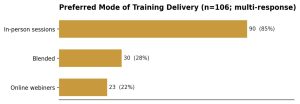
If the topics are clear, so is the preferred format. Asked which mode of training delivery best suits their conditions, 84.9% of respondents chose in-person sessions — by far the dominant preference, well ahead of blended formats (28.3%) and online webinars alone (21.7%). For communication of risk narratives more specifically, English and local-language materials were named almost equally (69.8% and 63.2% respectively), followed closely by visual aids such as posters and videos (58.5%), oral presentations (44.3%) and printed manuals (39.6%). Read together, these preferences describe a learning environment that is face-to-face, multilingual and visual — not a system that can be discharged through an app download or a one-off SMS blast.
Co-designing the story, not just receiving it
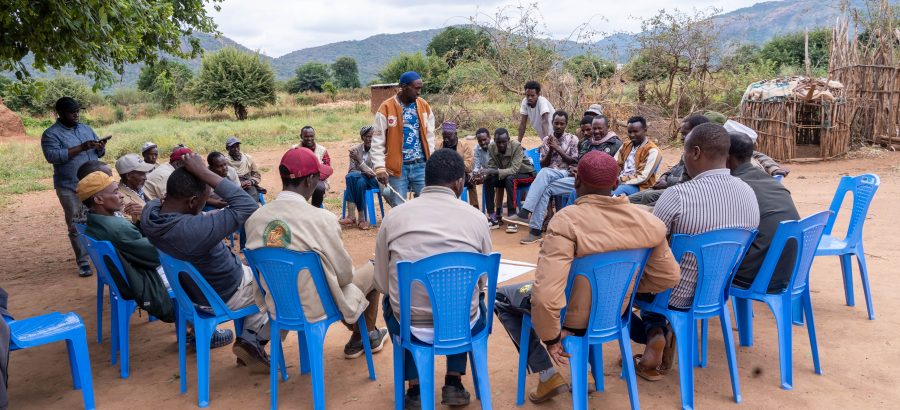
Perhaps the most substantive finding concerns not training but authorship. When asked how IGAD could best support communities in piloting risk narratives — the localised stories and forecasts meant to translate raw climate data into decisions people can act on — respondents did not simply ask to be told more. They asked to be involved. Training on interpreting and using risk narratives effectively led the list (87.7%), but close behind came a cluster of requests about participation and ownership: promoting inclusive participation for women, youth and marginalised groups (83.0%), engaging community leaders, elders and other trusted figures in the process (80.2%), and incorporating traditional knowledge and practices directly into the narratives themselves (77.4%).
| 83.0% want inclusive participation built in
Women, youth and marginalised groups named explicitly — co-design, not just consultation, is the clear community mandate. |
Testing and adapting narratives based on community feedback (54.7%) and regularly updating them as risks evolve (55.7%) round out a picture of risk communication imagined as an ongoing dialogue rather than a finished product handed down from a technical agency. This lines up precisely with an earlier finding in the same survey: when asked who they trust most for accurate climate information, respondents named elders and traditional knowledge holders ahead of every formal institution combined. A knowledge hub that treats community elders and traditional knowledge as inputs to be incorporated, rather than obstacles to be worked around, is not just more inclusive — the data suggests it is also more likely to be trusted, and therefore more likely to be acted upon.
The case for investing now
Put the pieces together and the argument for knowledge hubs stops being aspirational and starts looking like straightforward, well-evidenced resilience-building. Demand is essentially universal. The skills gap is specific and identifiable — technical and data-driven tools, not community-facing ones. The preferred format is known — in-person, multilingual, visual, participatory. And the design principle communities themselves are asking for — co-authorship with elders, women, youth and local leaders rather than one-way instruction — is exactly the model most likely to produce risk narratives people actually trust enough to act on.
For a project built on the premise that this region’s crises are usually forecast well and acted upon too late, that is close to a blueprint. A region this ready to learn is a region ready to close that gap — and PASSAGE’s own data has already mapped the way.